
Porsche 911 991.1 Buyer's Guide: The Last Naturally Aspirated Carrera
The 991.1 is the 911 that changed the platform. Longer, wider, more aluminum, electric steering, seven speeds — and, halfway through the run, one of Porsche’s most publicly documented recalls. Here’s what a used 991.1 actually is, which trims matter, and what to check before you buy.
What is the Porsche 991.1?
The 991 was the first all-new 911 platform in over a decade when it launched for the 2012 model year in the United States. The 991.1 denotes the pre-facelift cars, produced through model-year 2015 in Carrera form (Porsche facelifted the range to 991.2 for MY2016 with turbocharged flat-sixes). GT3, Turbo, and Turbo S variants arrived later in the 991.1 run and continued into MY2015.
The 991 chassis is longer in wheelbase and wider in track than the 997 it replaced, and its body is aluminum-intensive— noticeably lighter than the equivalent 997. Porsche also switched to electric power steering on the 991, a change that remains one of the most-discussed differences between the 991 and every earlier 911.
Quick facts
- Generation
- 991.1 (pre-facelift)
- US model years
- 2012–2015 (Carrera line)
- Base engine
- 3.4L flat-six naturally aspirated (Carrera)
- S engine
- 3.8L flat-six naturally aspirated (Carrera S)
- Transmissions
- 7-speed manual or 7-speed PDK dual-clutch
- Steering
- Electric power assist
- Body
- Aluminum-intensive
- Successor
- 991.2 (MY2016+, turbocharged Carreras)
Powertrain and transmission
The Carrera uses a 3.4-liter flat-six; the Carrera Suses a 3.8. Both are naturally aspirated and rev with the linearity that a turbocharged 991.2 or a 992 no longer offers. This is the last naturally aspirated Carrera 911 that Porsche built — a detail that matters more to some buyers every year.
Two transmissions are on offer: a seven-speed manual or a seven-speed PDKdual-clutch. The manual is distinctive to this platform — the seventh gear is a genuine overdrive with an intentional skip-shift interlock on some Carreras. Rear-wheel drive is standard; all-wheel-drive Carrera 4 and 4S variants add the 911’s familiar wide-body rear haunches.
Trim landscape
The 991.1 catalog covers most of what a 911 buyer would ever want:
- Carrera / Carrera S— the volume cars, Coupe and Cabriolet.
- Carrera 4 / Carrera 4S— all-wheel drive on the wide body. If wide-body proportions matter to you, this is where the 991.1 lineup gets interesting.
- Targa 4 / Targa 4S— the return of the roll-hoop Targa design, retractable glass roof, always all-wheel drive.
- GTS— added late in the 991.1 run for MY2015, bringing PASM adaptive dampers, the Sport Chrono package, and the Powerkit engine as standard. An example of what to look for.
- Turbo / Turbo S— twin-turbo 3.8, PDK-only, all-wheel drive. Introduced later in the 991.1 run. Compare to a low-mileage Turbo S example.
- GT3— MY2014 for the US market, PDK-only, rear-wheel drive.
What drivers and collectors value
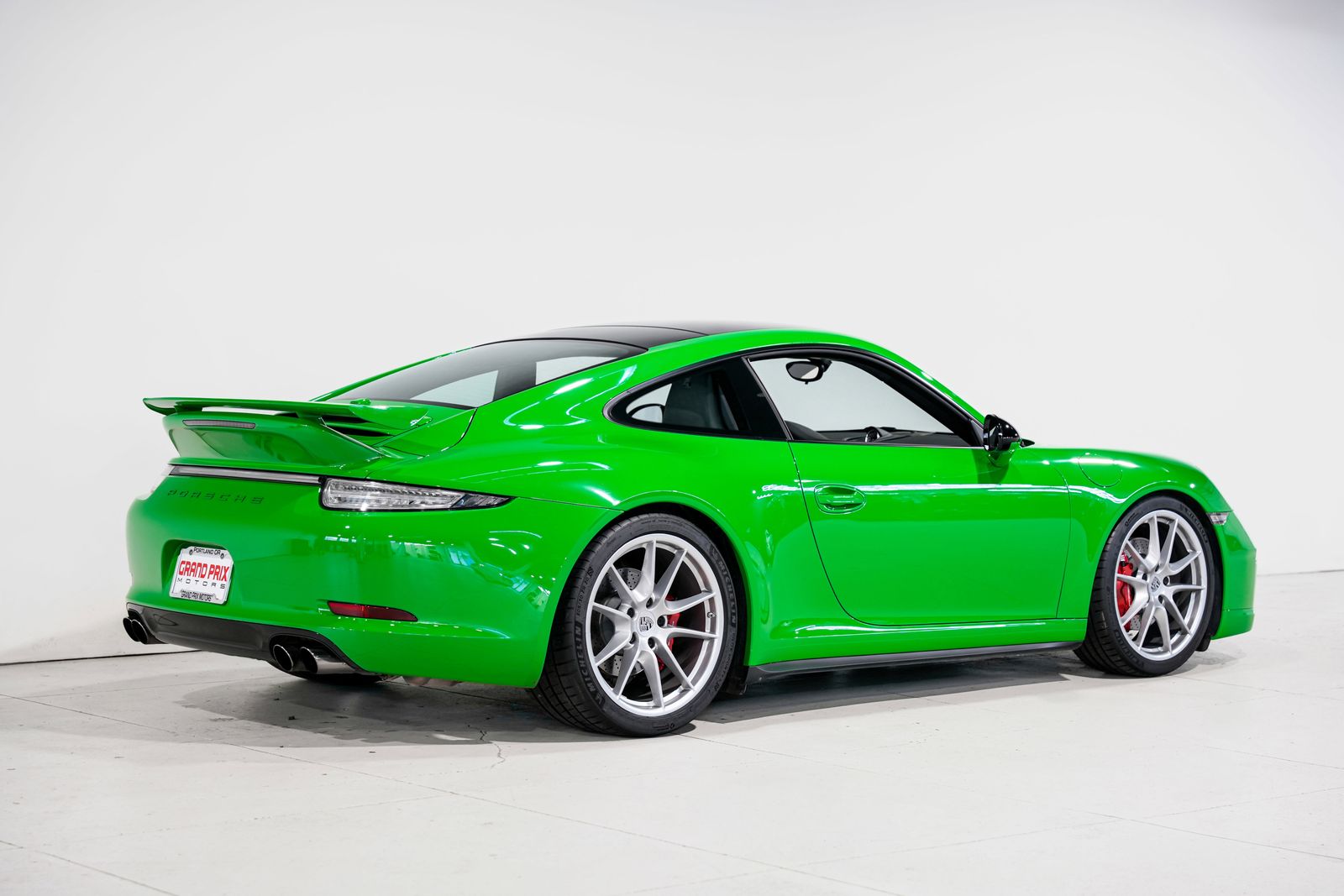
Enthusiast buyers gravitate toward a few things in the 991.1 market. The seven-speed manual commands attention on Carreras and Carrera Ss. The wide-body C4/C4S/GTS cars carry more visual presence than the narrow Carrera. And Paint-to-Samplecolors (rare factory-order finishes) stand out in a market otherwise dominated by silver, black, and white — the Viper Green C4S featured in our current inventory is a case in point.
Documented service history matters on every generation, and 991.1s are no exception. Sport Chrono, Sport Exhaust, PDLS+ headlights, and PCCB ceramic brakes are the options most commonly specified by buyers who drive their cars hard.
The 991.1 GT3 engine recall
Any honest 991.1 guide has to name it: Porsche recalled the entire early 991.1 GT3 fleet in 2014 after reported engine fires, and replaced every affected engine. Any 991.1 GT3 you look at today should have documented recall compliance— the recall campaign is well-tracked, and a specialist can confirm the service history on a specific car before you commit.
PPI checklist for a used 991.1
The 991 chassis is generally durable, but a proper pre-purchase inspection is still the single best de-risk for a car this age. Focus areas:
- Front-end paintwork— rock chips are common at the 991’s low nose. Look for touch-up quality and any respray boundaries under bright light.
- PDK software historyon dual-clutch cars — early builds saw updates worth confirming in the service records.
- Coolant hose condition on higher-mileage examples, especially cars driven in hotter climates.
- Accident history— the aluminum-intensive body is more expensive to repair correctly than the steel-heavier 997 that preceded it. A car with prior collision work needs documented repair records from a qualified shop.
- GT3s specifically— confirmed recall compliance and low-owner history are what informed buyers look for.
We welcome an independent PPI on every car we sell. Our default is to make the car available to whichever inspector you choose, at your expense — that’s the single most useful step for a remote buyer.
Buying a 991.1 from Grand Prix Motorcars
Grand Prix Motorcars is an independent, Porsche-focused dealer in Portland, Oregon. We hand-pick 991-generation 911s across Carrera, GTS, Turbo, and GT variants, and deliver nationwide, enclosed or open transport, from our showroom.
For remote buyers, a live video walk-around with a specialist — FaceTime, WhatsApp, or Zoom — is the standard we use instead of an in-person test drive. Custom photos and PPI coordination are available on request. Browse our current 991.1 inventory, or return to the full 991 generation hub for cars from both halves of the platform.
FAQ
What years is the Porsche 991.1?
US model years 2012 through 2015 for the Carrera line. GT3, Turbo, and Turbo S variants arrived later in the run and continued into MY2015. Porsche facelifted the range to 991.2 for MY2016.
Is the 991.1 Carrera naturally aspirated?
Yes. The 991.1 Carrera uses a 3.4-liter naturally aspirated flat-six; the Carrera S uses a 3.8. Porsche moved the Carrera line to turbocharged flat-sixes with the 991.2 facelift for MY2016.
Does the 991.1 come with a manual transmission?
Yes. A seven-speed manual is offered alongside the seven-speed PDK dual-clutch. Both are unique to the 991 platform.
What is the 991.1 GT3 recall?
Porsche recalled the early 991.1 GT3 fleet in 2014 after reported engine fires and replaced every affected engine. Any 991.1 GT3 you look at should have documented recall compliance in its service records.
How does the 991 chassis differ from the 997?
The 991 is longer in wheelbase and wider in track, and its body is aluminum-intensive. It also introduced electric power steering, replacing the 997's hydraulic system.
Grand Prix Motorcars hand-picks 991-generation 911s across Carrera, GTS, Turbo, and GT variants and delivers nationwide.
Related guides

Shipping a Porsche 911 Across the Country: What to Expect
Buying a car you have not seen in person is the easy part. Getting it to your driveway in the same condition it left the lot is where most of the questions come in. Here is what actually happens between sold and delivered.
Read the guide →
964 vs 993: Choosing Your Air-Cooled 911
The last two air-cooled 911s. The 964 modernised the classic silhouette; the 993 finished the story with multi-link rear suspension and VarioRam. Engineering, driving character, and the PPI checklist for either.
Read the guide →